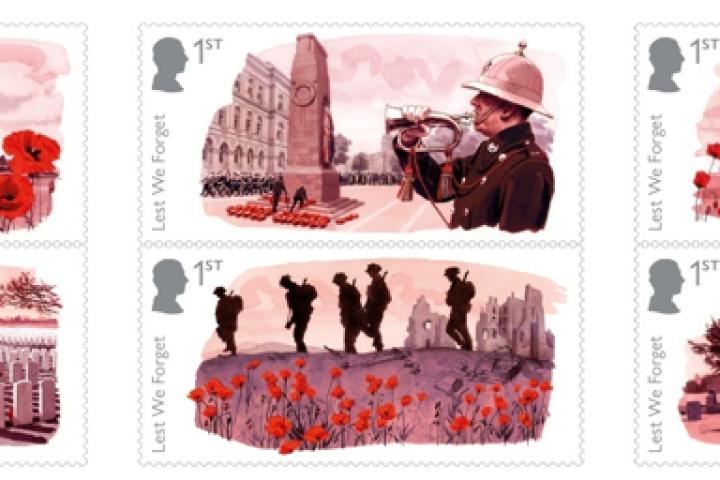
Royal Mail has today revealed images of a set of six new Special Stamps honouring the service and sacrifice of the nation’s Armed Forces.
The stamps will be issued on Armistice Day, 11 November, one of the UK’s most significant occasions of collective remembrance, marked by acts of reflection across the country. This year also marks 110 years since the Battle of the Somme, which began on 1 July 1916 and became one of the defining battles of the First World War.
The six stamps feature specially commissioned artworks by British artist Matthew Cook, reflecting different aspects of Remembrance. Each has been painted using a colour palette inspired by the red poppy, one of the most enduring and recognisable symbols of remembrance.
The stamp images feature:

Saluting an RAF flypast.

Royal Marines bugler at the Cenotaph.

First World War soldier.

Laying of wreaths at Tyne Cot Cemetery.

Second World War soldiers.

Laying of wreaths at a village war memorial.
David Gold, Royal Mail, said: “Remembrance holds a profound place in our national life. Through these stamps, we pay tribute to the service and sacrifice of those who have served our country through two world wars, and many other conflicts. Matthew Cook’s poignant artworks provide a fitting and powerful way to reflect on the sacrifices made by so many courageous men and women across the generations.”
Artist, Matthew Cook said: “Remembrance has a very special place in my life, having served as a reservist in the Parachute Regiment and The Rifles and been deployed to Iraq and Afghanistan. I was delighted to be asked to illustrate these stamps and to take on the challenge of such a sensitive and significant subject. It is always a privilege to illustrate stamps for Royal Mail, and this project felt particularly special.”
Remembrance:
Remembrance Sunday has its origins in Armistice Day, beginning in 1919, on which the approximately 1.1 million British and Empire military war dead of the First World War were formally remembered.
Every year since then, veterans of all ranks, from many different countries and services, have paraded through central London, pausing to salute the military dead of war at Lutyens’s Cenotaph on Whitehall.
Initially built as a temporary wooden structure, the Cenotaph became a permanent stone memorial in 1920. The Cenotaph (meaning empty tomb) has such symbolic importance because the bodies of many members of the armed forces were not repatriated. The large numbers also recorded as simply ‘missing’, with no body to bury, meant that the Cenotaph acted as a surrogate gravestone for many.
Armistice Day continued to be marked at the Cenotaph and other war memorials erected across the country and worldwide. After the Second World War, the ceremonies moved to Remembrance Sunday, the Sunday closest to 11 November each year. They now commemorate the dead of all wars and conflicts since 1914.
The stamps, and a range of collectible products, are available to pre-order from today (27 October) at www.royalmail.com/remembrance2026 and by telephone on 03457 641 641. A Presentation Pack including all six stamps is priced at £11.70. The stamps go on general sale from 11 November.